

Best Customised Badge Printing Tips for Growing Businesses
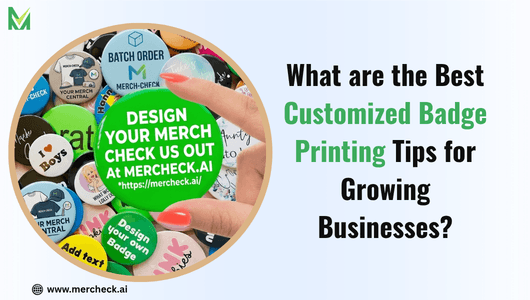
Bring your brand to life with custom merchandise. Design your own high-quality promotional badges, pins, and custom gear directly at mercheck.ai.
Discover expert tips on customised badge printing-design, sizing, materials, and QR codes-to create professional badges for your business.
A badge feels like a very small item, but it is a very big part of your brand identity.
For first startups and growing businesses, who often see new employees and trainees every day, a badge can help them identify their employees anywhere.
Plus, a badge helps you promote a brand at events, support networking, and create a more professional appearance overall. The promotional products industry is continuing to grow, and this is why businesses are investing in physical branding more.
In the U.S., promotional product sales reached $27.1 billion in 2025, up 1.3% from the previous year. (PPAI)
But printing a logo on a batch is not enough. As a brand, you need to care for design, material, information, finish, and printing quality.
They all matter!
Now the question is how to make the best customised badge for your brand?
Customised Badge Printing
Customised badge printing helps businesses create professional identity badges for employees, events, conferences, and networking. With personalised names, designations, logos, and QR codes, badges combine identification with brand visibility.
1. Start With a Clear Purpose
Before you design the badge, decide what you actually want it to achieve. First ask what it is for.
- Employees?
- Trade show?
- Conference?
- Product launch?
- Networking event?
- Customer identification?
For example:
- An employee badge may need a name, photograph, designation, and company logo.
- An event badge may need the attendee's name, company, QR code, and access category.
Every badge has different goals, and you must understand the purpose to get the best results.
2. Keep the Design Simple
It's true that badges have very limited space. You cannot set a lot of information on them as it will be very difficult to read. So instead, follow a simple visual hierarchy:
Logo → Name → Designation/Company → QR code or other essential information
Here are some practical tips:
- Make the person's name one of the most visible elements.
- Keep important information highly readable.
- Place branding and QR codes strategically.
- Use your brand colours and fonts consistently.
This helps your employees or attendees look like part of the same organisation.
3. Choose the Right Badge Size
When choosing a badge, size is one of the most important factors you should consider.
- Choose too small, and it would make names and job titles very difficult to read.
- Choose too large, and your badge may feel uncomfortable or look unprofessional.
Moreover, consider how the badge will be worn. You can choose among lanyard, clip, pin, holder, or magnetic attachment.
But here is what you should consider. The badge format should match the environment and the expected duration of use.
For example:
- Choose a lightweight badge for a one-day networking event.
- Choose a durable badge for everyday usage.
4. Use High-Quality Branding
A badge is not just a name tag. It's a part of your market strategy. Always go for high-quality, detailed branding.
Some of the common mistakes brands make are as follows:
- Blurry Logo
- Complex Fonts
- Poor Colour Choices
- Poorly Reproduced Colour
These signs show you are careless. Moreover, check your brand colours before production. But most importantly, order a proof or sample before bulk deals. A simple rule is this: if your logo doesn't look sharp on the badge, don't approve the final batch.
5. Add QR Codes Where They Make Sense
Your customized badge can become a digital gateway. You can use a QR code for people to visit:
- Your website
- Product catalogue
- LinkedIn profile
- Event schedule
- Registration page
- Digital business card
- Lead-generation form
Now, here is what you should consider.
Don’t make the QR code unnecessarily small. People should be able to see and scan through multiple phones first. If you want to use it for events, QR codes help you to support check-in, lead capture, session tracking, and networking.
Personalised T-Shirt Printing
Personalised T-shirt printing allows businesses to create unique apparel with custom logos, names, slogans, graphics, or event designs. It is ideal for corporate events, team building, promotions, uniforms, and brand campaigns.
6. Select Material Based on Usage
Don’t choose a badge based only on its price.
- For short events, choose economical paper or synthetic options.
- For repeated use, choose durable materials such as PVC, acrylic, metal, or laminated cards.
You can also choose durable materials for facing moisture in outdoor events.
Moreover, sustainability is going mainstream in recent years. PPAI estimates that sustainable products generated $3.8 billion. This is about 14% of total promotional product sales in 2025. (PPAI)
So, when it suits the event, you should explore more eco-friendly materials.
7. Create Different Badges for Different Roles
Same badges can create confusion. So, the best would be choosing different badges for different roles such as:
- Employees
- Managers
- Vendors
- Speakers
- Guests, and
- VIPs.
Give different badges to different groups. You can change the colour, labels, icons, or layouts.
For example:
- STAFF
- SPEAKER
- VIP
- MEDIA
- VISITOR
This helps when you organise large events.
8. Don't Sacrifice Quality for Bulk Discounts
Ordering your badges in bulk may cost less, but what about the quality? Until you are 100% sure about the printing, materials, and timely delivery, choosing the cheapest option is not the best way.
You should consider the following factors to choose the right printer:
- Material quality
- Printing method
- Colour accuracy
- Finishing
- Turnaround time
- Minimum order quantity
- Reprint policy
- Customisation options
Remember, quality and value matter more than cost.
Customised Backpacks
Customised backpacks combine everyday utility with professional branding. Businesses can personalise them with logos, employee names, team designs, or event branding, making them useful corporate gifts and long-term brand visibility tools.
9. Always Test Before Mass Printing
One small spelling mistake can ruin an entire batch.
Before approving the final order, check:
- Names
- Job titles
- Phone numbers
- Website URLs
- QR codes
- Logo placement
- Colours
- Spacing
- Alignment
- Print quality
If you are printing personalised badges, conduct a sample print first. This is especially important when information is being generated from a large employee or attendee database.
How Can Mercheck Help With Customised Badge Printing?
Mercheck helps businesses create professional customised badges for employees, conferences, events, exhibitions, and corporate programmes.
From design and material selection to personalised printing and bulk production, Mercheck helps businesses create badges that balance branding, readability, durability, and functionality.
Conclusion:
Customised badges are very small but powerful branding options. It is more than an identification card. It is a compact branding tool that travels with your team and puts your brand in front.
Customers, prospects, clients- everyone sees it.
In this blog, we have discussed the best tips to make premium-quality badges. The simple answer is this. Your badges should balance branding, readability, durability, and functionality.
Keep minimal design, high-quality printing, the right materials, and smart features to add real value. Need expert partners for manufacturing badges in bulk? Connect with Mercheck today.
FAQs:
1. What is customised badge printing?
Customised badge printing allows businesses to create badges with personalised names, photographs, designations, logos, QR codes, and other details for employees or events.
2. What are customised badges used for?
Customised badges are commonly used for employee identification, conferences, trade shows, seminars, corporate events, networking events, and access identification.
3. Which materials can be used for customised badges?
Depending on the purpose and budget, badges can be made using PVC, acrylic, metal, laminated cards, paper, or synthetic materials.
4. Can badges include employee names and photographs?
Yes. Employee badges can include names, photographs, designations, departments, company logos, and other essential information.
5. Can QR codes be added to customised badges?
Yes. QR codes can link badges to websites, digital business cards, event schedules, registration pages, catalogues, or lead-generation forms.
6. How can businesses maintain badge quality in bulk orders?
Always check a physical sample or proof before mass printing. Verify names, colours, logo placement, QR codes, materials, finishing, and overall print quality.
Amit Singh
I am a driven and analytical professional bringing more than 11 years of experience in business mark...
Read more about author